Interview
You Don't Look Sick
Artwork by Mary Bell Sott
I was not born sick.
That is one of the things I want people to understand. Rare disease is often imagined as something distant, something genetic, something that happens to someone else. But I became sick around the age of thirty-nine, after a life in which I had studied commercial art, specialized in photography, and learned how to look closely at the world. Back then, I photographed landscapes. I documented beauty outside of myself.
Then my body became the landscape I had to study.
For years, I knew something was wrong. My body changed. It swelled in places. Bruises appeared. Symptoms came and went. I felt myself becoming someone other people could not see clearly. But because I did not look the way people expected illness to look, I was dismissed. I was misdiagnosed with psychiatric conditions and fibromyalgia. I was told, in different ways, that what I was experiencing was not what I knew it was.
No one thought to look deeper.
The tumors were there. Adrenal tumors. But they were treated as incidental, as unimportant, as the kind of finding that shows up on a scan and is too easily ignored. What I later learned was that I had MACS — mild autonomous cortisol secretion — a form of cortisol excess that is only beginning to be more widely recognized and studied. Many people familiar with Cushing’s disease have still never heard of MACS, even though it can quietly damage a person’s body and life for years.
Because adrenal incidentalomas are often assumed to be nonfunctional, many patients never receive the hormonal testing that could reveal what is actually happening. In my case, both tumors were functional and destructive. One was as large as the adrenal gland itself. But for years, no one tested the hormones that would have shown the truth.
It took me finding the scans myself.
I found the evidence of the tumors and brought it to my primary care physician. I advocated for myself until I was referred to an endocrinologist. It was not the emergency room that caught it. It was not the system noticing on its own. It was me, searching through my own records, holding up the evidence of my own illness, and insisting that someone finally look.
By then, I had already spent more than a decade fighting to be believed. I also fought for disability for nine years, because when you do not look sick, people assume you are not sick enough. When your disease is invisible, the burden often falls on you to make it visible.
Eventually, both of my adrenal glands were removed.
The surgery was necessary, but it was not a cure in the way people imagine cure. It did not return me to the life I had before. It exchanged one disease process for another lifelong condition. Now I live with adrenal insufficiency, Addison’s disease. My body no longer makes the hormones it needs to survive. I depend on steroids every day. I carry emergency medication. If I vomit and cannot absorb my pills, I can become dangerously ill very quickly.
I live one missed dose, one episode of vomiting, one medical emergency away from death’s door.
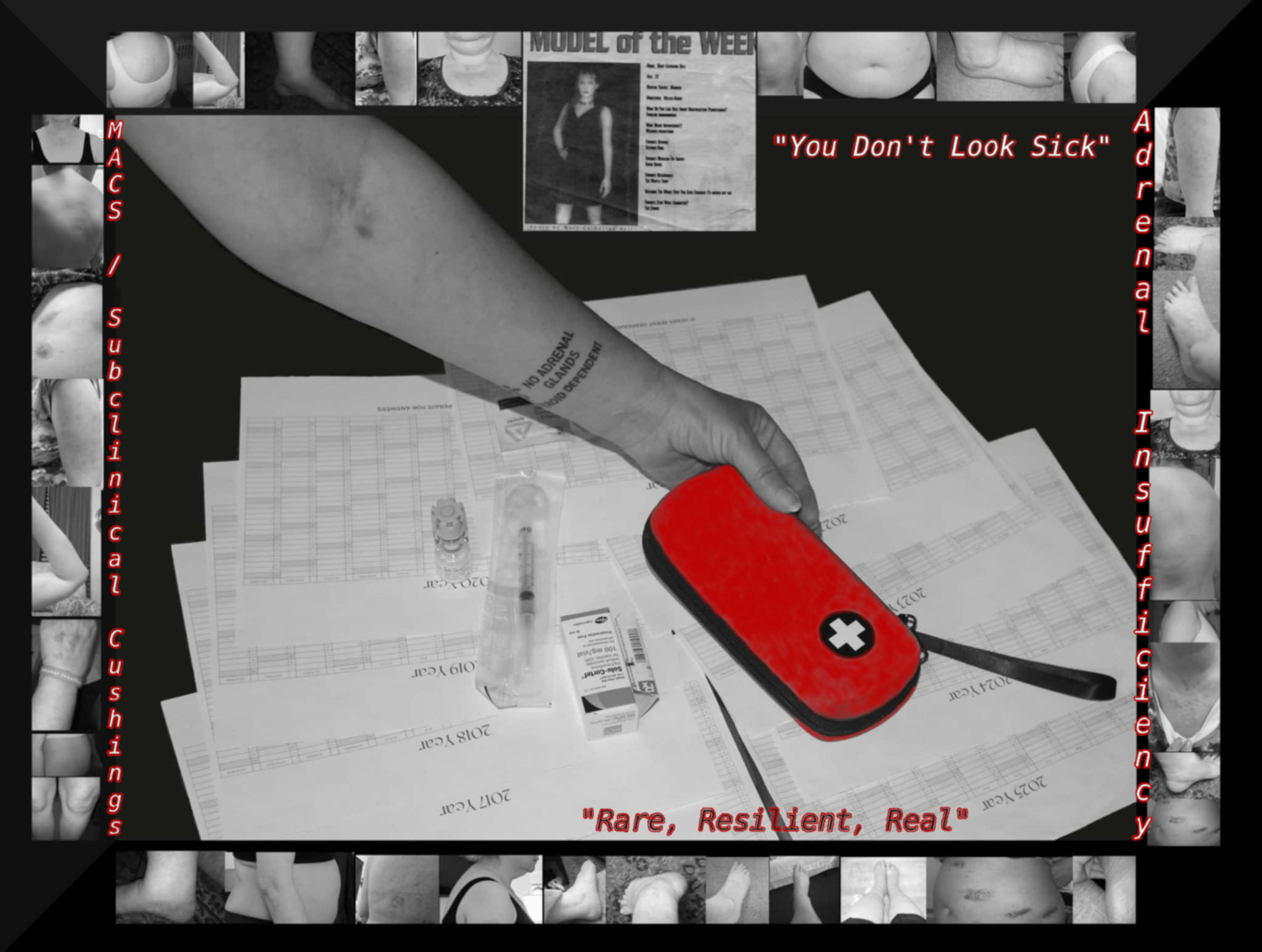
That is why the emergency kit appears just out of reach in one of my self-portraits. That is why the medications matter. That is why the calendars matter. That is why the bruises matter. They are not decorative. They are evidence.
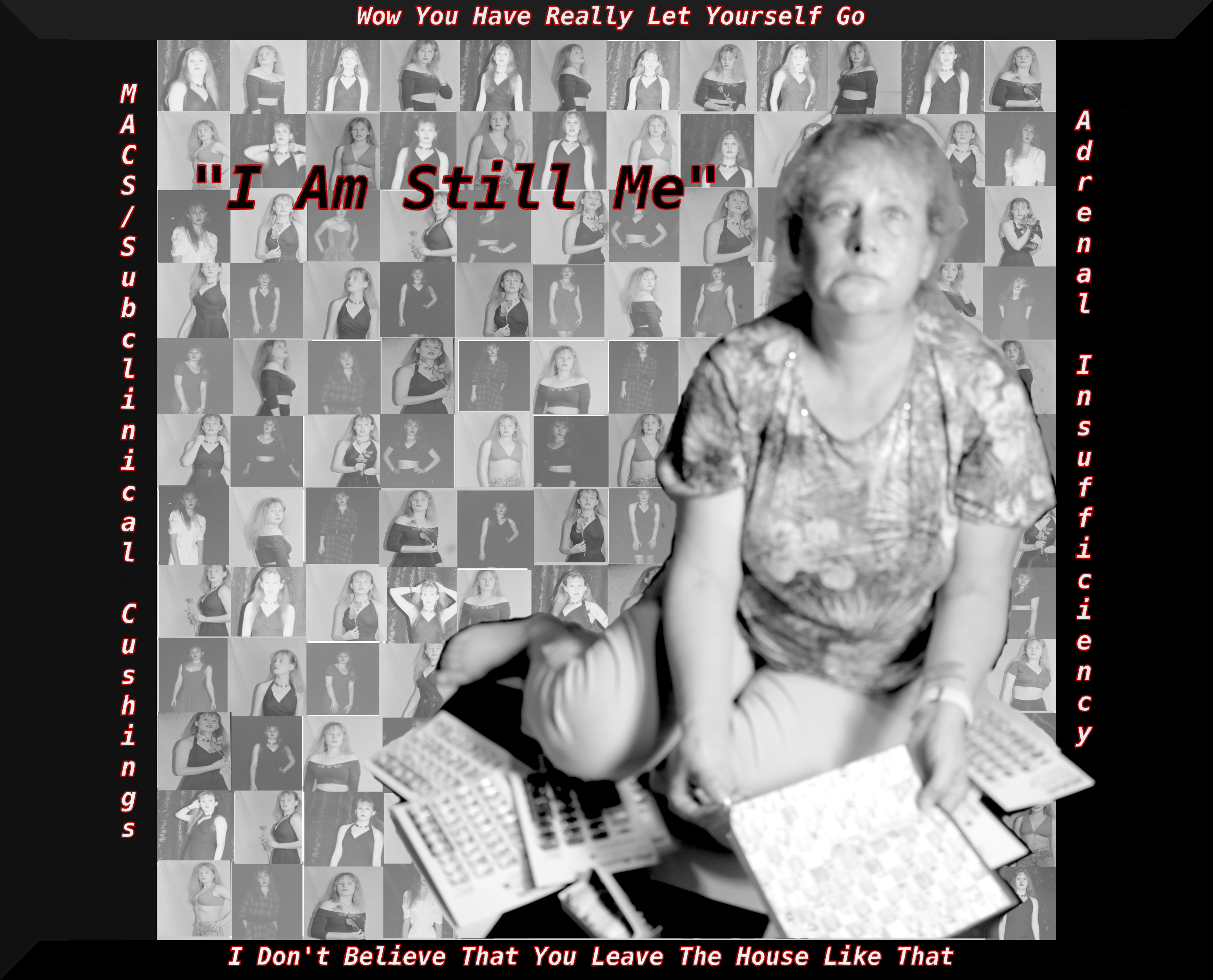
In one piece, I sit in front of a grid of photographs from my past. Across the image are the words, “I Am Still Me.” The woman in those photographs existed before the illness was named, before the surgery, before the medications, before the constant vigilance. She is still there. Illness changed my body, my routines, my future, but it did not erase me.
In another piece, my arm reaches toward a red emergency kit. Around the border are images of swelling, bruising, skin changes, and pieces of a body altered by disease. The words read, “You Don’t Look Sick.” That phrase is familiar to many people with invisible illness. It sounds harmless, but it can become a wall. It can delay care. It can deny suffering. It can make a person feel like they have to perform their illness in order to be believed.
Photography became my way of answering that phrase.
Before I was sick, I used photography to capture the world. Now I document everything: my body, my symptoms, my medications, my medical records, the timeline of what happened and what was missed. Documentation became survival. It became memory. It became protest.
I am still learning what this new life requires. Steroids keep me alive, but they also bring complications. I worry about osteoporosis. I worry about my stomach, my teeth, my future. I think about possibilities like a cortisol pump, something that might spare my body from the damage of taking steroids orally. Even now, after diagnosis and surgery, I am still learning how to live inside the answer I fought so long to receive.
That is part of why this story matters beyond me. Once hormonal testing of adrenal incidentalomas becomes routine, MACS may become the answer for many people who have spent years being misdiagnosed, dismissed, or told their symptoms are psychiatric, vague, or unexplained. For patients like me, the problem was not that there was no evidence. The problem was that no one looked closely enough at the evidence already there.
What I want people to know is simple: rare disease can happen to anyone. A person can look fine and still be fighting for their life. A person can be told for years that nothing is wrong while their body is being damaged from the inside. A person can be dismissed, misdiagnosed, doubted, and still know the truth of their own body.
My art is not only about illness. It is about self-advocacy. It is about strength. It is about justice. It is about the danger of systems that stop looking when a patient does not fit the expected image of disease.
I photograph because I had to prove I was sick.
I create because I am still here.
And I am still me.
I was not born
with this name for pain.
It came later,
quietly,
inside a body
everyone thought
they understood.
You don’t look sick,
they said,
as if illness
must announce itself
with a uniform,
as if suffering
must be visible
to be true.
So I learned
to become my own witness.
I photographed the swelling,
the bruises,
the skin,
the calendars,
the years
that did not believe me.
They called them incidental,
as if a tumor
could be harmless
while rewriting
the chemistry
of my life.
MACS had been speaking
in a language
no one tested for.
My body knew
before the chart did.
I held my records
like evidence.
I found the tumors
they had missed.
I carried my body
back into the room
and said:
Look again.
Now my life
fits inside blister packs,
inside steroid bottles,
inside the red emergency kit
I reach for
when survival
becomes urgent.
The cure
was not a cure.
It was a trade:
two adrenal glands
for a lifetime
of vigilance,
one disease
for another,
one body
for the same soul
still living inside it.
I used to photograph landscapes.
Now I photograph
the country of my own body,
the terrain
of what was ignored,
the proof
that invisible
does not mean
imagined.
Look closer.
Listen earlier.
Believe the person
before the damage
has to become
evidence.
Rare,
resilient,
real
I am not what was missed.
I am not only
what was removed.
I am not the diagnosis
they finally found.
I am still here.
I am still fighting.
I am still me.